



by Sarah B. Ottow, Founder and Director of Confianza, Author of The Language Lens
I have spent much of my career thinking about the difference between intent and impact.
We can intend to include someone and still exclude them. We can intend to help and still create another barrier. We can care deeply about people and still participate in systems that cause harm.
Good intentions matter. But they do not erase impact.
I learned this long before I had professional language for it. Growing up, I watched my younger sister, who has significant disabilities, be misunderstood and mistreated because of something entirely outside her control. I watched my parents tirelessly advocate for her when systems believed they were including her, but she was still being left out. Years later, as a teacher and then an educator working with students of all ages learning English, I began recognizing versions of the same pattern.
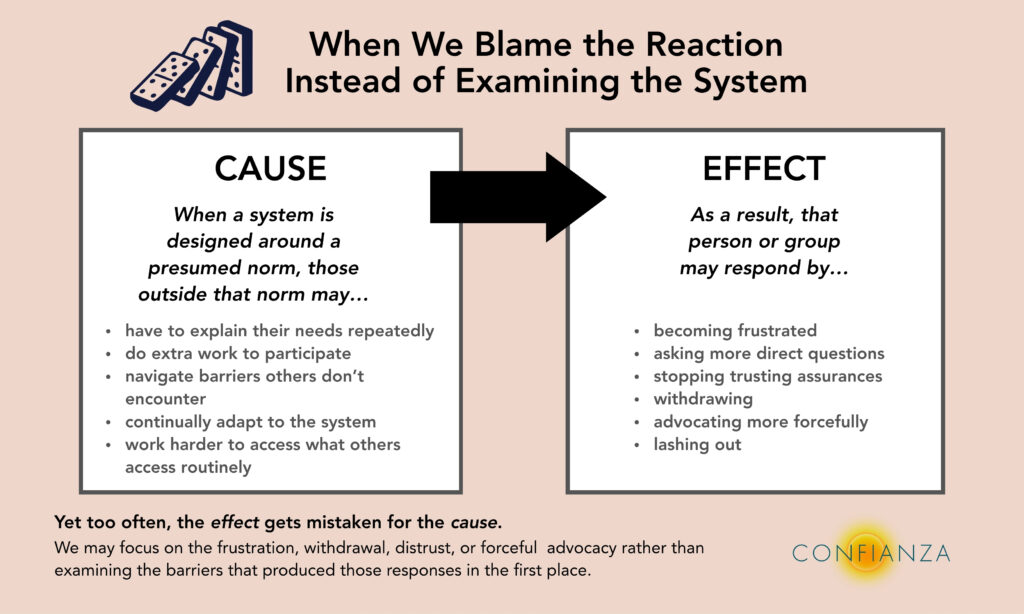
A system is built around a presumed norm. Someone falls outside that norm. A barrier appears. And then something important happens. We start watching the person instead of the barrier. For example, the student stops participating. The parent becomes frustrated. The person advocates more forcefully. They stop trusting assurances that things will be different next time. Eventually, they may become angry or feel otherized. And suddenly, their reaction is the problem.
Living with celiac disease has made this pattern personal in a way I had not experienced before.
Eating gluten free isn’t a lifestyle preference for me; it is medically necessary. And yet so many of the systems that organize ordinary life—restaurants, social gatherings, travel, conferences, celebrations—are built around the assumption that everyone can safely participate in food in roughly the same way.
That means participation often requires additional work from me before I ever arrive. I research menus. I create lists. I call restaurants. I ask servers about preparation practices and cross-contact. I ask to speak to the manager to verify protocols. I explain what celiac disease means. I explain what cross-contact is so ingredients or surfaces are not contaminating gluten free ingredients or processes. I bring my own food a lot. I eat ahead of time in case. Sometimes I decide that the safest option is simply not to participate.
Most of the people I encounter are trying to be helpful. Often, they genuinely want me to be included. But good intentions do not automatically remove the barrier. A workaround offered after I discover that I cannot safely participate still leaves me responsible for identifying the problem, explaining it, and helping to solve it.
And that repeated adaptation has a cost. The exclusion is rarely dramatic. More often, it accumulates in small moments: being the person who has to ask again, research ahead, eat beforehand, bring something separate, sit at a table without eating, or decide whether participating is worth the physical risk or social discomfort. And sometimes, it means having to name the contradiction when something is called inclusive but still leaves you out.
Over time, what can look from the outside like a minor inconvenience becomes something else: the continual experience of moving through systems that were not designed with you in mind.
And when I advocate for what I need—especially after explaining it more than once—I may sound frustrated. I may need to ask more direct questions. I may stop trusting assurances that everything will be fine. I may feel paranoid or dismissed. Through this compounded exclusion and subsequent frustration, I may be perceived as a major pain in the neck.
This is where the pattern becomes especially important to me. If attention shifts to my frustration, my persistence, or the inconvenience of accommodating me, we can lose sight of what produced the response in the first place.
The problem becomes the person who is reacting to the barrier rather than the barrier itself. There it is. You see, the actual cause is inequity in the system. The effect is the response of the person who is not being fully included by that system. Yet too often, the person experiencing the inequity gets blamed for their response to it.
The effect gets mistaken for the cause. The frustration, withdrawal, anger, or persistent advocacy becomes the problem to solve, rather than the conditions that produced it in the first place.
And for the person who doesn’t “fit” the system’s presumed norm, that can create yet another layer of exclusion.
The system presumes a norm. The barrier appears. The person is asked to adapt. The burden accumulates. The person reacts. And the reaction becomes the problem.
That is how alienation can happen even inside communities and organizations that sincerely intend to include people.
Living this has made me think differently about something at the heart of my life’s work. Equity isn’t simply about whether we intend to welcome everyone. It isn’t even about whether we’re willing to help once someone encounters a barrier. It requires us to examine who is continually being asked to adapt—and who isn’t.
It requires us to listen when someone tells us that the solution we’ve provided isn’t actually removing the barrier. And perhaps most importantly, it requires us to resist interpreting people’s responses to inequitable conditions without examining the conditions themselves.
This matters enormously in schools. When a multilingual learner withdraws from classroom discourse, what is that response revealing? When a student becomes frustrated after repeatedly being unable to demonstrate what they know, what is that response revealing? When a family arrives at the fourth meeting considerably less patient than they were at the first, what has happened during the first three? When someone tells us, This isn’t working for me, do we become defensive because we were trying to help? Or do we get curious about the impact?
Intentions matter. But if we want to understand whether inclusion is actually happening, we also have to listen to the people experiencing the impact.
This is also why listening matters so much. Listening isn’t waiting for someone to explain their experience in exactly the tone, language, or manner that makes it easiest for us to hear.
Sometimes frustration is data. Sometimes withdrawal is data. Sometimes anger or alienation is data. Sometimes the response we most want to correct is telling us exactly where we need to look. Because when a system creates harm and then alienates people because of how they respond to that harm, we haven’t solved the original problem. We’ve compounded it.
And sometimes the most important question we can ask isn’t: What’s wrong with this response? It’s: What is this response revealing about the experience we created?
Help isn’t actually responsive if the helper stops listening to what the person says they need. Sometimes help itself can become part of the problem. When helping requires one person to remain the helper and another to remain the person being helped, we haven’t necessarily created inclusion. We may have created dependency—and an unequal power relationship.
The cultural concept of confianza asks something different of us. It asks us to build relationships grounded in mutual respect and trust: to listen before solving, to believe people when they tell us what they need, and to preserve their agency in the process.
The question isn’t only, “Am I trying to help?” It is also, “Does the way I’m helping leave this person with more agency—or less?”
The Difference Between Helping and Confianza
I first encountered the concept through the Funds of Knowledge research that emerged from Mexican communities in Tucson, Arizona. González et al. (1995) challenged educators to reject deficit assumptions about students and families and instead recognize the extensive knowledge, skills, relationships, and resources already present in their households and communities. Central to this work was confianza—the mutual trust that develops through reciprocal relationships.
That word stayed with me. My understanding of it deepened through years of living, learning, and working in communities throughout Latin America and in culturally and linguistically diverse U.S. neighborhoods. Confianza became foundational to how I understood relationships, teaching, learning, and equity—and, eleven years ago, the name I chose for my company.
It is not charity. It is not rescuing. It is not doing something for someone without listening to what they are telling us they actually need.
Helping can be generous and well-intentioned while still becoming hierarchical when one person retains the authority to define the problem, determine the solution, and decide what constitutes sufficient support. The relationship becomes: I have access, knowledge, or power. You have a need. I will help you.
Instead, confianza recognizes that the other person brings knowledge too—including knowledge we cannot possess because they are the one experiencing the system.
Sometimes we become so invested in helping that we stop noticing whether the person we’re helping still has meaningful agency. And when they tell us, Actually, this isn’t the help I need, we may experience their response as rejection, resistance, or even ingratitude.
But what if we listened differently? What if instead of asking, Why won’t this person accept the help I’m offering? we asked: What is this person’s response telling me about the help I’m offering?
We learn with and from one another. That’s mutual respect. That’s confianza. We can sincerely intend to help someone and still diminish their agency. We can intend to include someone while continuing to center a system that excludes them. We can care deeply and still get it wrong.
In my view, confianza doesn’t require perfect people with perfect systems. It requires enough mutual trust to believe someone when they tell us about the impact our system—or even our help—is having on them. And enough humility to listen.
Citation:
González, N., Moll, L. C., Tenery, M. F., Rivera, A., Rendón, P., Gonzales, R., & Amanti, C. (1995). Funds of knowledge for teaching in Latino households. Urban Education, 29 (4), 443–470.
Continue the learning with Confianza ☀️
Explore resources for educators and instructional leaders working to create learning environments grounded in rigor, discourse, engagement, and student ownership.
Welcome!
At Confianza, our free article collection helps educators explore insights and tips to help you lead with clarity, and confidence—so you and your students, can reach your highest potential.

By submitting your email address, you agree to our Privacy Policy and Terms and Conditions.


