


by Sarah B. Ottow
“Active learning” has become one of those phrases we hear often in education—but not always with enough clarity.
Too often, active learning gets reduced to whether students are talking, moving, or participating in something visible. And while those things can matter, they do not automatically mean learning is active in any meaningful sense.
Students can be busy and still be passive.
They can complete tasks, turn and talk, fill out organizers, or rotate through activities without doing much real thinking. They can follow directions, stay engaged, and look productive while still remaining fairly passive in relation to the actual learning. Sometimes we may call this being compliant.
To me, the difference between active and passive learning is not just about what students are doing on the surface. It is about the level of cognitive engagement underneath it.
Passive learning happens when students are mainly receiving, repeating, identifying, or complying without needing to make much meaning for themselves. Active learning happens when students are making sense of ideas, connecting concepts, explaining their thinking, using language with purpose, and doing the intellectual work of learning rather than just completing the task.
That distinction matters. Because in many classrooms, what looks active is not always producing deep learning. A student may be participating, but not really processing. They may be answering, but not explaining. They may be word calling, but not comprehending the text. They may be engaged in the activity, but not fully accessing the thinking behind it.
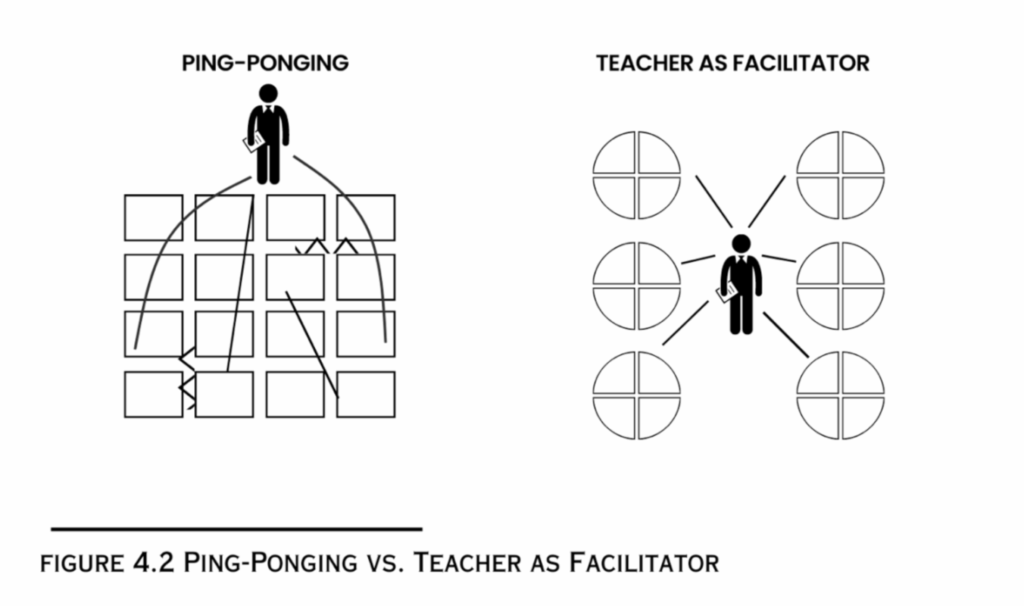
Figure 4.2 from The Language Lens for Content Classrooms, 2nd Edition: Moving from teacher-directed “ping-ponging” to teacher-guided, structured facilitation creates more opportunities for students to actively engage and learn with and from one another.
Facilitating Active Learning
This is why I pay so much attention not just to participation or being a compliant learner, but I also pay attention to what students are being asked to think about, say, and do. Real active learning requires more than visible engagement. It requires clarity, purpose, and instructional design that invites students into deep thinking and ownership of the learning process. It requires teachers to be more facilitative and release more control to learners to make their own meaning.
The goal is not simply to make learning look active. The goal is to make sure students are actively making meaning. That’s what true learning is! 🌱
Ready to Put Active Learning Into Practice?
Creating more active learning means giving students more opportunities to think, talk, make meaning, and increasingly take ownership of their learning.
Go deeper with the Language Lens™ Book Bundle, including my bonus workshop, Creating the Conditions for Student Ownership Through the Language Lens™, and practical tools you can use right away.
→ Get the Individual Book Bundle
Bringing this learning to your team? → Get the Team Book Bundle
Welcome!
At Confianza, our free article collection helps educators explore insights and tips to help you lead with clarity, and confidence—so you and your students, can reach your highest potential.

Get Our Go-To Self-Assessment + Guide
ON YOUR MINDSETS + PRACTICES FOR INSTRUCTIONAL EQUITY
By submitting your email address, you agree to our Privacy Policy and Terms and Conditions.


